
By Sally Pritchett
CEO
Frontline employees aren't inherently hard to reach. The challenge is designing communication around how they actually work.
Saying frontline employees are “hard to reach” no longer washes. Too often, “hard to reach” becomes shorthand for communication that has been designed around office-based ways of working. Frontline employees aren’t inherently hard to reach; they’re hard to reach through communication created for people who sit at desks, check emails throughout the day and have regular access to an intranet.
The problem therefore isn’t necessarily reach, or channels. It’s a design problem.
Asking the wrong question creates the wrong solution
Instead of asking, “How do we get this message to frontline employees?”, reframe the question to, “How do we design this communication around the reality of their working day?”
That distinction matters.
One in five frontline workers say they hear about major organisational change through the grapevine rather than directly from leaders. Trust in executive leadership sits at just 35% among frontline employees, compared with 54% among desk-based colleagues. And frontline workers are more than twice as likely to say they spend no time reading communication updates.
It would be easy to look at that final statistic and conclude that frontline employees simply aren’t engaging.
But there’s a much more useful question to ask: Do they genuinely have the time, access or reason to pay attention in the first place?
Because too much organisational communication still starts with the same assumptions: that people have a work email address, regular access to a screen, time to read during office hours, a relatively quiet environment and scheduled opportunities to hear from leaders. For millions of frontline employees, none of those things can be taken for granted.
They may be working shifts, moving between locations, operating equipment, supporting customers or delivering time-critical services. They may technically have access to a platform, but no realistic opportunity to use it.
So when communication is designed around desk-based assumptions, frontline colleagues are left to do the adapting. They have to find the message, work out whether it’s relevant, translate the corporate language into what it actually means for them, and somehow fit all of that around their working day.
Start with the person, place and pressure
One reason frontline communication can feel difficult is that the word “frontline” hides an enormous amount of variation.
A cabin crew member, engineer, care worker, warehouse colleague and station team member might all be described as frontline. But their working realities are completely different. They face different pressures, work in different environments and have very different opportunities to access communication.
So before thinking about channels, first consider the person.
What do they already know? What does their role involve? What language do they use? How familiar are they with the subject? And what access to communication do they genuinely have?
Then, the place.
Where will they encounter the communication? On a shift? At a site? In a vehicle? In a customer-facing environment? At home between shifts?
And finally, pressure.
What else is demanding their attention at that moment? Safety? A customer? An operational deadline? Noise? A dozen other messages competing for attention?
That’s what should influence the communication before the channel or creative execution is decided. When communication is built around the realities of a distributed workforce, the audience suddenly becomes a lot less “hard to reach”.
Reaching the frontline, where they are
“One of my favourite frontline projects was a strategy launch for Yodel. The brief was simple: understanding of the strategy couldn’t stop at manager level. It had to reach the frontline too. Mission accepted.”
Sally Pritchett, CEO, Something Big
When Yodel asked us to launch its new strategy across the frontline, the first step was understanding how people actually worked.
At the time, its frontline workforce included around 11,000 employed colleagues, agency workers and self-employed or contracted drivers and couriers, spread across the UK. Many spent limited time in hubs or service centres and there was no single digital channel that could reliably reach everyone.
So rather than trying to force a digital solution, we looked for something people already had in common: regular team briefings.
We created a physical, visually led session aid that managers and supervisors could use to run a short strategy briefing wherever their teams happened to be, from a rest room to a corner of a warehouse.
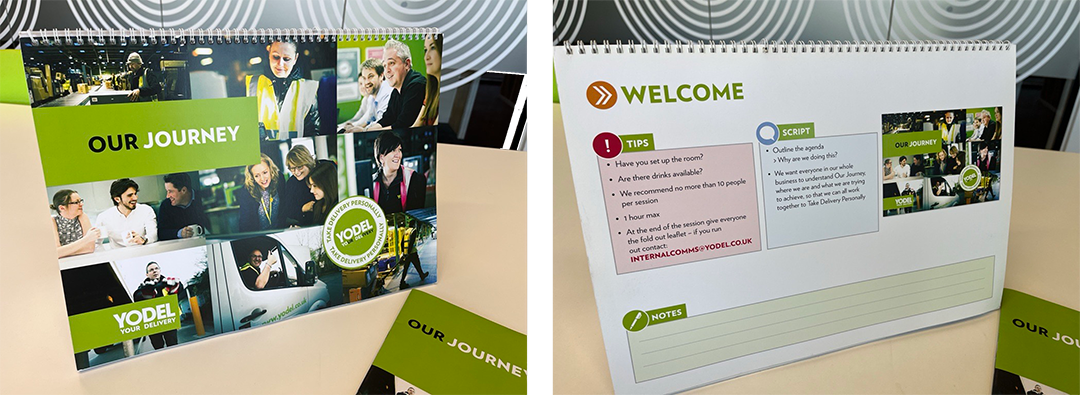
The session required no advance preparation. The aid included a simple script, questions to prompt discussion and guidance to help managers respond. It was designed to be practical, robust enough for an operational environment and, most importantly, easy to use.
We also tested it with frontline teams before launch, making sure the content made sense, felt relevant and spoke to people with the respect their roles deserved.
The result was strong reach across the workforce, exceeding our targets. Pre and post-session surveys also showed a measurable increase in understanding of the strategy.
Create communications for notice, understanding and action
Once you understand the person, place and pressure, the next question is whether the communication has been created to work in that reality.
Start with three simple tests:
Will they notice it?
Not just: Have we sent it or published it? But will it actually show up somewhere that makes sense in the flow of their day?
That might be a shift handover. A safety huddle or toolbox talk. A break area. A digital screen. A manager conversation. A one-page prompt.
None of these are especially exciting new communication channels. That’s partly the point.
Instead of constantly asking employees to go somewhere else for communication, we can take communication into moments that already exist. Fit the message into the rhythm of work, rather than adding another task to the working day.
Will they understand it?
Frontline employees shouldn’t have to decode corporate language or work out for themselves why something matters.
The message needs to be clear, relevant and easy to grasp quickly. What’s changing? Why does it matter? And what does it mean for me, in my role?
Can they act on it?
There’s little value in asking someone to do something if the realities of their working day make it difficult or impossible.
So the final test is whether the communication leads to an action that is realistic in the context of the role, the environment and the pressures they are working under.
Design for the frontline, not the desktop
Frontline employees aren’t hard to reach because they work differently from office-based colleagues. They become hard to reach when communication asks them to adapt to a system that wasn’t designed around them.
So, the next time we describe an audience as “hard to reach”, perhaps we should look at the communication first.
Because if we understand the person, the place and the pressure – and design around what they need to notice, understand and act on – reaching them might not be the hard part after all.