
By Sally Pritchett
CEO
Why gamification could be a game-changer for internal behaviour change
Let’s start with a little pop quiz…
Question 1: What’s the name for using game mechanics in non-game situations to encourage engagement and influence behaviour?
- Playification
- Gamification
- Fun theory
- Gamer psychology
Question 2: Which of these could help employees practise decision-making?
- A board game involving risks and rewards.
- A card game full of real-life workplace dilemmas.
- A team challenge that tests their judgement.
- All of the above.
Question 3: What have you just done?
- Read some internal communications advice.
- Taken part in a quick game.
- Procrastinated for 30 seconds.
- Wondered where this is going.
The answers? B, D and B.
(Although we’ll also accept C or D for the last one. No judgement here.)
Just like that, you’ve experienced a little gamification. A few simple questions have hopefully sparked your curiosity, encouraged you to participate and given you a reason to keep reading. And that’s why gamification and game-based learning have a serious role to play in employee behaviour change.
The power of purposeful play
Gamification and game-based learning both draw on some powerful principles of behavioural science. While gamification adds elements like points, rewards and leaderboards to everyday activities, game-based learning uses games themselves to help people learn.
Both encourage active participation, making learning more engaging and easier to remember. They also tap into our natural curiosity and competitive nature, while creating a safe space to try new skills, learn from mistakes and explore different perspectives.
And there’s research to back it up. A recent review of 49 workplace studies found that gamification has the potential to improve employee motivation, engagement and knowledge retention (Uwakwe Udeh et al., 2025).
Of course, making something fun doesn’t automatically change behaviour. The magic happens when the experience is designed around what you actually want people to think, feel and do differently.
Let the games begin
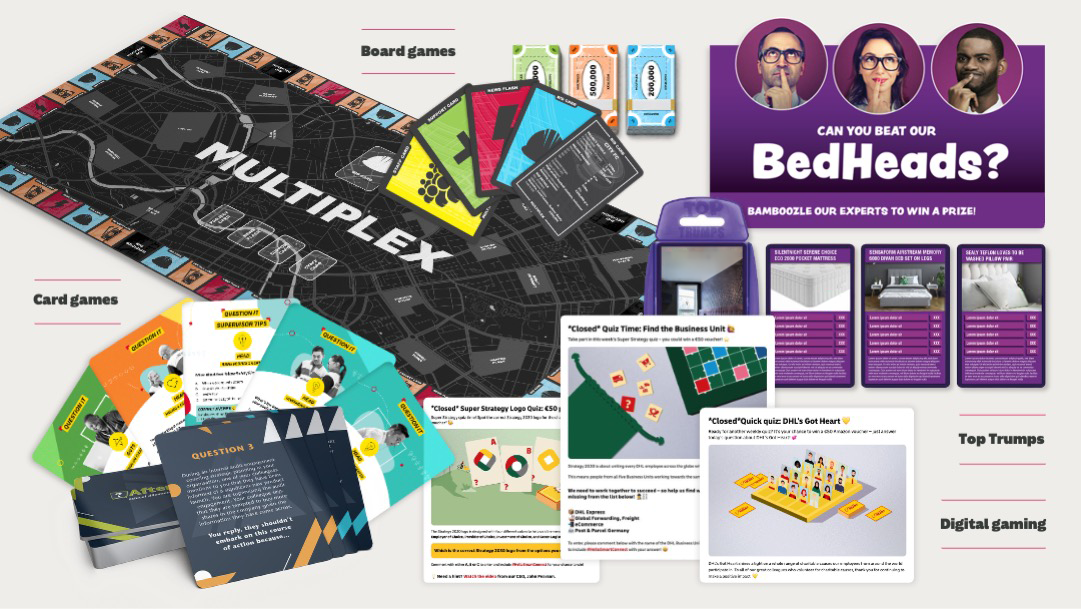
Whether you’re launching a new five-year business strategy, bringing company values to life or helping your teams grow their knowledge, gamification and game-based learning offer plenty of creative possibilities. And it doesn’t have to be expensive, complicated or even digital – sometimes the simplest ideas can have the biggest impact.
- Board games that bring decision-making to life. Imagine teams navigating business challenges, bidding for resources and taking calculated risks. If your strategy prioritises both innovation and customer satisfaction, would you trial an untested idea or stick with a proven approach? Every choice influences what happens next, making board games a creative way to explore business strategy, develop leadership skills or practise thinking on your feet.
- Card games that challenge employees to beat the experts. How much do colleagues really know about cybersecurity, sustainability or company products and service? Pitch them against subject matter experts in a battle of knowledge and give everyone a reason to brush up on the facts.
- Dilemma games that spark debate. How would you handle a difficult customer interaction, a logistics challenge or a workplace safety concern? Scenario-based games encourage colleagues to explore different viewpoints and debate tricky workplace decisions and trade-offs.
- Games that make behaviours memorable. Think charades, multiple-choice questions or describing an attribute without naming it. More engaging than memorising a list of company values, and a great way to get colleagues thinking about what those behaviours look like in practice. For example, acting out active listening could help managers understand how to make colleagues feel heard and supported.
- Weekly quizzes that keep people coming back. A little friendly competition can give employees a reason to visit your app or internal channels regularly. When aligned with your internal communications calendar, fresh topics, regional leaderboards and occasional prizes can help keep organisational priorities front of mind.
Play anywhere, remember everywhere
Games are particularly effective for reaching frontline teams. A pack of cards in a break room or a quick challenge between shifts can get colleagues involved without needing a laptop or login. Add some creative branding and you’ve got an employee experience that’s uniquely yours.
They’re also particularly valuable for onboarding, helping new starters quickly get under the skin of the business and build connections with their colleagues.
And shared experiences are far more memorable. Employees might forget a values presentation, but they’ll remember the hilarious charades performance or the dilemma that divided the room. Those conversations can continue long after the game is packed away.
More than just a game
The real opportunity isn’t simply to make internal communications more entertaining. It’s to create the kind of immersive employee experiences that money can’t buy through traditional communications alone. Because when the lessons go beyond the game and make a difference in everyday working life, everyone’s a winner.
Get in touch to explore how a more playful approach to internal communications can help you engage your people and support behaviour change.