

What makes mergers work: people and culture communication after the deal
By Sally Pritchett
CEO
Mergers don’t fail on strategy. They stall when people don’t know how to operate in the new organisation. Here’s how THRIVE helps close that gap.
Mergers and acquisitions promise growth, efficiency and new capability. But the real challenge begins after day one, when people and cultures need to come together. How do you help people understand how to operate in a new organisation?
When two businesses combine, they bring different cultures, expectations and ways of working. Leaders are often ready to move forward, having spent months shaping the deal. Employees, on the other hand, are still working through what the change means for their role, their team and their future. Uncertainty builds, assumptions fill the gaps and behaviours don’t shift in the way the organisation expects.
The challenge is not simply to communicate what is changing. It is to help people understand how the new organisation works, what is expected of them and how they fit within it.
Our proprietary THRIVE methodology provides a practical way to focus that effort, helping organisations build fairer, healthier and happier workplaces by elevating how they communicate with their people. Working through the six interconnected pillars – Talent, Human, Roadmap, Inclusion, Values and Experience – enables communication to act as the golden thread after a merger or acquisition.
Talent: recognising that the deal has changed for employees
A merger changes the psychological contract, whether it is acknowledged or not. While leadership may be focused on future opportunities, employees are often reassessing what they are part of and whether it still works for them. Career paths may feel less certain, expectations may shift and what once felt stable can quickly become unclear. If that shift is not addressed directly, people will draw their own conclusions about what the change means for them.
Communication needs to:
- Clearly acknowledge what has changed, not just what is staying the same
- Set realistic expectations about what employees can expect going forward
- Reduce ambiguity before people fill the gaps themselves
Human: understanding how people are experiencing the merger
Mergers are often communicated as structured, logical processes. In reality, employees experience them as uncertainty, ambiguity and, at times, loss of control.
While communication may focus on sharing updates, it can miss the underlying concerns people are working through day to day. The questions that matter most are often the ones not being asked openly.
Communication should:
- Surface the real concerns and questions people may not be raising openly
- Create opportunities for two-way dialogue, not just top-down messaging
- Reflect the reality of what people are experiencing, not just the intended narrative
How well are you tuning in to your workforce? Check where a more human approach to communication could make a difference with this diagnostic.
Roadmap: making the integration feel navigable
One of the most common frustrations for employees after a merger is not knowing what is happening next. Day one communications can create momentum and excitement, but they rarely provide enough detail for employees to understand how the change will unfold over time. In the absence of that clarity, people fill the gaps themselves, often with assumptions that don’t align with reality.
Communication needs to:
- Be explicit about what is known, what is not yet clear and what is still evolving
- Break the journey into stages so people can see what changes now and what comes next
- Reinforce progress regularly so the integration feels active, not static
Inclusion: recognising that not everyone experiences the change in the same way
Communication during a merger does not land evenly across the organisation. While some employees feel informed and included, others may hear later, receive partial information or rely on second-hand updates. This is often more pronounced for frontline teams, part-time colleagues, night workers or those temporarily away from the business. Over time, these gaps can lead to very different levels of understanding and trust.
Communication should:
- Reach different audiences in ways that work for how they access information
- Close gaps where some groups are hearing later or less clearly than others
- Create space for questions and feedback across all parts of the workforce
Values: making sure shared values are understood the same way
It is common to identify shared values early in a merger, and on the surface they often appear aligned. However, the way those values are interpreted and applied in practice can differ significantly. Without exploring those differences, organisations risk assuming alignment where it does not fully exist. This can show up later in decision-making, behaviours and expectations.
Communication needs to:
- Translate values into clear, observable behaviours
- Highlight where interpretations may differ across legacy organisations
- Reinforce what “good” looks like in the new organisation through real examples
Experience: aligning what people hear with what they feel
Culture is shaped less by what is said and more by what people experience day to day. In a merged organisation, there are often many signals that still reflect the previous identity. Team structures, ways of working and informal practices can all reinforce a sense that little has changed, even when communication suggests otherwise.
Paying attention to these everyday moments, and ensuring they align with the intended direction, helps communication feel credible and supports integration in practice.
Communication should:
- Align messaging with what employees actually experience day to day
- Call out inconsistencies between what is said and what is happening
- Make the new organisation visible through practical, everyday moments
Where communication turns alignment into action
Mergers do not succeed because leadership is aligned at the top. They succeed when that alignment is clearly communicated and understood across the organisation.
This is where HR and internal communication teams play a defining role. Not just sharing updates, but translating the deal into everyday reality. Helping people understand what has changed, what is expected and how to operate within the new organisation.
If you are preparing for a merger or working through integration, we specialise in strategic people and culture communications, helping organisations translate the deal into something that works in practice for their people.
You can explore the THRIVE methodology here or get in touch to talk through how we can support your integration.


Whitepaper: The resilience gap
By Sally Pritchett
CEO
Why people and culture communication sit at the heart of risk strategy
Risk is shifting. Organisations are navigating a far more volatile and emotionally charged environment than even a few years ago. While many have invested heavily in operational, financial and cyber resilience, a different and less visible risk is growing: human capital risk.
The rise of human capital risk
Employees are experiencing sustained change, increasing pressure and rising scrutiny. Engagement is declining, managers are overstretched, and reputation is shaped in real time by employee voice. Resilience is no longer only about systems and controls, but about your workforce’s ability to adapt, stay engaged and move forward with confidence.
This whitepaper explores the resilience gap – the growing mismatch between the pace of change and employees’ capacity to absorb and adapt.
Inside, you’ll find:
- The six interconnected people risks reshaping business resilience
- Why resilience breaks down under sustained change
- A clear case for placing people and culture communication at the core of risk strategy
If you are responsible for people, culture, risk or transformation, this paper will help you connect employee experience with organisational resilience in a practical and strategic way.
Building organisational resilience through communication
Complete the form below to download your copy of the whitepaper.

What psychology teaches us about organisational change
By Sally Pritchett
CEO
Change programmes rarely fail because the idea is wrong. They fail because behaviour doesn’t shift.
Before the pandemic, the average employee experienced around two major organisational changes a year. Whether it’s new strategic priorities, changes in leadership or different ways of working, research from McKinsey suggests that number is closer to ten today.
And yet, most change communications programmes still start from the same place: “Here’s the strategy, here’s the plan, here’s why this matters.” But narratives alone won’t change behaviour.
If organisations are launching new strategies, transforming technology and expecting multiple generations to work harmoniously side-by-side, then we need to design and communicate change around how humans actually behave, not how we wish they behaved.
McKinsey has also reported for years that around 70% of change programmes don’t fully achieve their intended outcomes. Right now, employees are tired and worn down by constant adjustment. On the surface they might seem compliant and engaged, but as a communicator or business leader, you might be wondering why their habits don’t shift day-to-day.
Which raises an interesting question: how do we design communication that shifts behaviour at work?
Here are seven psychological principles we draw on when helping organisations design change communications that shift behaviour:
1. Show me people like me
We are far more influenced by what our peers are doing than by what senior leaders tell us to do. If you want adoption of an AI tool or a new way of working, don’t just showcase the executive sponsor. Show the operations manager who’s using it weekly. The frontline team who’ve found a smarter way of working or the sceptic who changed their mind.
Research consistently shows that peer influence is one of the strongest drivers of behaviour change. When people see “people like me” already doing something, they are much more likely to adapt their own behaviours.
2. Make the new behaviour easier than the old one
We often tend to view hesitation as resistance. Sometimes it is, but often the new way simply feels harder.
Behavioural science has shown repeatedly how effective defaults are. From pension enrolment to software settings, as humans, we tend to go with what’s already pre-selected. Not because we’ve evaluated all the options, but simply because we’re busy.
In organisations going through big changes, the cognitive load on employees is already high, so if a new process requires extra steps, new logins or additional admin, people will naturally revert to what they know.
3. Reduce cognitive overload
When employees are navigating so much change, overwhelm may be a genuine barrier to anything new. Chunking – the concept of breaking change down into clear, manageable steps – is well known to reduce cognitive strain and overwhelm.
Instead of launching a five-year strategy as one narrative, think about communicating what changes this quarter, what changes this month and what changes tomorrow.
That way people can see where they are in the journey, what they can expect in the near term and their confidence in the change improves. Without that, even the most exciting changes can feel too big to take on.
4. Communicate what’s at stake
Understandably it’s easy for organisations to lean into the opportunity of change and underplay the risk. The upside of AI. The growth potential of a new market. The efficiencies of a restructure.
Of course, those things still matter, but emotionally, humans are naturally more sensitive to loss than gain. The discomfort of losing something familiar often far outweighs the appeal of something new.
Handled thoughtfully, it can be powerful to acknowledge what’s genuinely at stake. Not in a dramatic, scaremongering way, but in an honest one. What happens if we don’t adapt? What might we fall behind on? What could become harder for our customers?
Being clear about what’s genuinely at stake helps people understand the trade-offs and adds some urgency to why behaviour change is needed.
5. Language shapes reaction more than we realise
Is AI replacing roles? Or is it removing repetitive tasks so people can focus on higher-value work? Is a restructure a cost-cutting exercise? Or is it an investment in long-term capability?
The underlying message may not change, but our inbuilt emotional responses mean the message can land very differently. Particularly when employees are fatigued, the nuance of tone becomes even more important. Remember that people aren’t just taking on board a message, but also looking for reassurance, safety and stability in a volatile world.
These small shifts in language can significantly alter how a new programme or initiative lands.
6. Choice matters
Another insight that is consistently true is that people are more likely to support a change when they feel some level of ownership over it.
But that’s not crowdsourcing opinion and strategy, it’s about helping employees understand that change isn’t always happening to them. Even modest degrees of perceived choice can increase engagement. For example – options around how training is accessed, opportunities to feed into local implementation, or being part of a pilot group can all help employees feel involved in the shift. People are much more likely to commit when they feel part of it.
7. Is progress tangible enough?
One of the biggest reasons change or transformation loses energy is that progress is hard to see or track. Our brains naturally seek reward and the dopamine that comes with it, which is why elements of gamification in the context of change can be so effective.
Immediate feedback, visible progress and a little healthy competition can make even the most mundane tasks feel more engaging. Time-bound initiatives, recognition for experimentation, team challenges or leaderboards that show how teams are moving forward can all help. Used thoughtfully, these kinds of initiatives help create momentum and encourage employees to adopt new habits.
What role does communication play?
The most important thing we’ve learned supporting organisations through change is this: communication cannot carry behaviour change alone. But there are things we can build into communication programmes that make behaviour change far more likely.
Our role isn’t just to craft compelling narratives. It’s to think about the human response – how people feel when they read a message, what they hear from their leaders and what a new change might genuinely mean for their day-to-day work.
It may sound obvious, but when employees are navigating constant transformation, AI acceleration and some of the challenges that come with multiple generations working side by side, logic alone rarely shifts behaviour.
Instead, we need to think about change with the lens of how people actually operate:
- how we compare ourselves to others
- how we respond to potential loss
- how we process complexity
- and how much autonomy we feel we have
That’s where thoughtful, creative people and culture communication – grounded in human psychology – becomes a necessity.
We specialise in Strategic People & Culture Communications, helping organisations connect strategy, culture and everyday behaviour. By combining behavioural insight with brand-level creativity, we turn messages into momentum and help change take hold in the reality of everyday work. If you’d like to explore how these ideas might apply in your organisation, we’d love to talk.

Transforming safety culture: from awareness to everyday behaviour
By Sally Pritchett
CEO
With World Safety Day approaching, it's time to think about how a day of safety awareness can grow into sustained behavioural change.
Safety is rightly a priority in most organisations. Policies exist, training is delivered and awareness days are celebrated and well intentioned. With World Day for Safety and Health at Work coming up on 28 April 2026, how can you ensure that the attention does not fade and that safe practice becomes part of everyday decision-making rather than something revisited once a year?
That was the focus of a recent Work Wonders conversation, where Nicola Curtis, Head of Health and Safety at Biffa, Renata Juste Gomes, HSE Global Senior Director at DHL Supply Chain and Simon Strong, Director of Learning at Download Learning joined our CEO, Sally Pritchett, to reflect on their experience of communicating safety across frontline workforces.
Making safety part of the job itself
At Biffa, an upward trend in high-potential near misses involving mobile plant prompted a closer look at what more could be done. Instead of issuing further instructions, the team began by listening. Drivers were invited into the conversation and asked what would genuinely support them to operate more safely.
As Simon explained during the session, health and safety cannot sit alongside the job as an additional layer. It needs to be embedded within competence itself. If safety is embedded within competence, communication has to align with that, speaking to professionalism rather than compliance.
The resulting “Aim for Success” programme focused on building intentional habits around reversing manoeuvres. The emphasis was not on listing hazards, but on encouraging anticipation, situational awareness and deliberate intention before movement. The language was carefully shaped to reflect how people speak on site, avoiding unnecessary technical terminology.
Although the training was initially designed for individual completion, teams chose to go through it together. That decision created space for discussion and reflection, which in turn led to practical improvements. In one depot, an operative identified a blind spot and requested mirrors to remove the risk.
Simplicity without patronising
If Biffa’s focus was on embedding safety within a specific operational context, DHL’s challenge was scale and diversity. Operating across more than 220 countries, with significant variation in language, culture and working environment, communicating consistently requires deliberate simplicity.
Renata described the deliberate effort to remove complexity from the message. In developing the “Our Safety is in Our Hands” campaign together, we focused on intentional simplicity in both visual identity and language so that it could travel across regions without losing meaning. Achieving that simplicity required discipline, with tone conveying respect for highly skilled frontline roles and imagery working across cultures and languages. In some cases, symbols that resonated in one region had to be reconsidered in another.
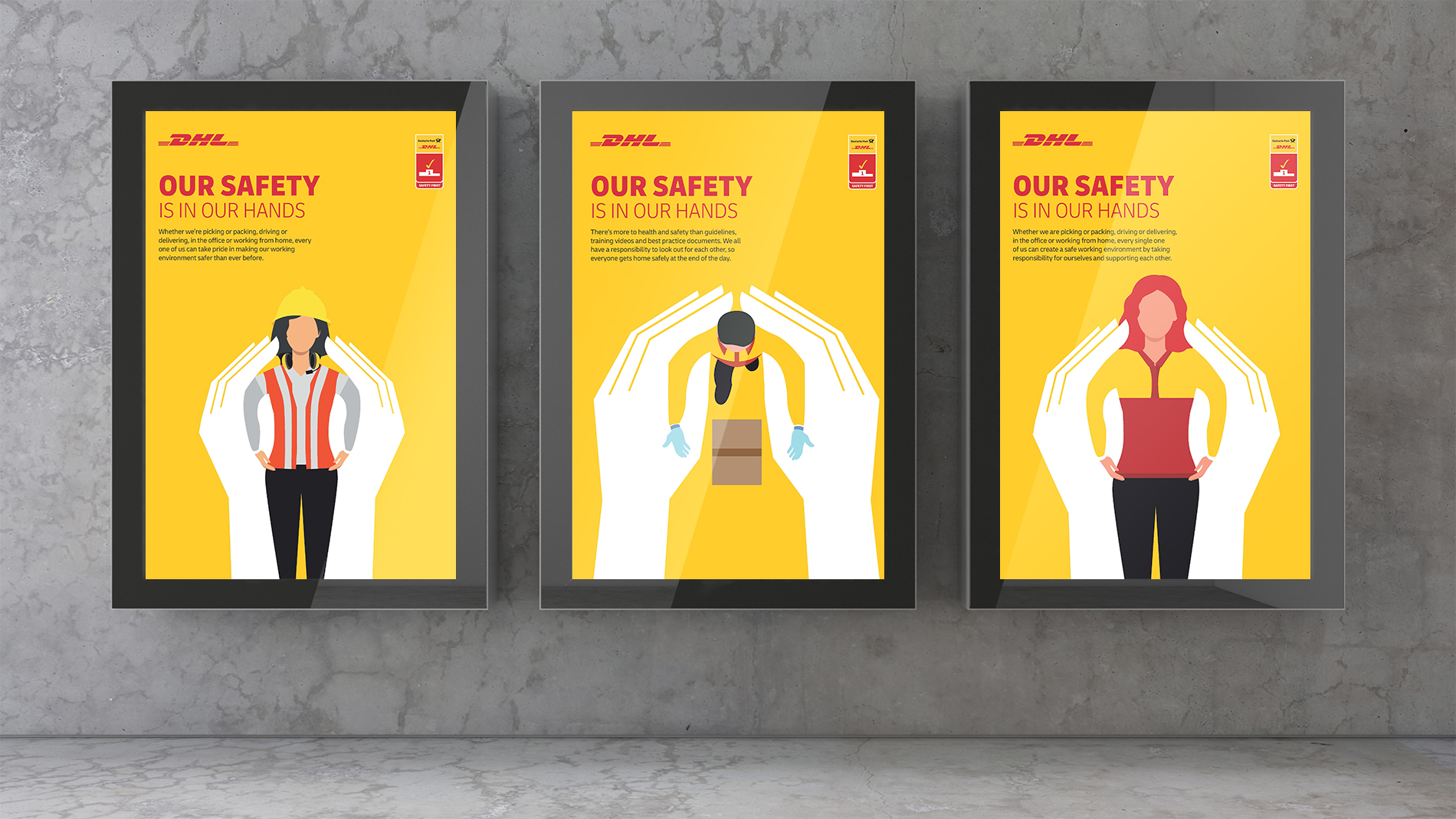
Importantly, the campaign was never intended as a single annual moment. While World Safety Day provided a useful focal point, the broader approach was always-on. Messages were broken into manageable themes and revisited throughout the year, with visual materials reinforcing conversations already taking place in team briefings and leadership discussions.
Local teams were encouraged to adapt the campaign in ways that made sense for their context. What felt engaging in one country might look different in another. That flexibility did not dilute the message; it strengthened its relevance.
Ownership and accountability
Across both case studies, ownership emerged as a defining factor. At DHL, the framing is explicit: safety sits in everyone’s hands. It is not confined to a function or a department. Managers, supervisors and frontline colleagues all play a role in holding standards and raising concerns.
At Biffa, drivers were positioned as professionals whose expertise shaped the training content itself. When people feel trusted and responsible, behaviour becomes more consistent. That is why messages that rely solely on instruction rarely create lasting commitment, whereas communication that reinforces identity and shared standards is more likely to endure.
Avoiding complacency
A question raised during the session was how to prevent complacency over time. How do you stop visual materials becoming part of the background?
The panel agreed that motivation alone is not enough. Habits are more powerful than short bursts of enthusiasm. Sustained behaviour change relies on repetition, visible leadership commitment and regular, meaningful conversation.
World Safety Day can act as a catalyst by creating a moment to pause and reflect. However, without consistent reinforcement throughout the year, the effect diminishes. Sally described this through a simple analogy: awareness days can act like fireworks, capturing attention briefly, but what sustains culture is the steady bonfire that keeps people gathered in conversation.
For those responsible for communicating health and safety, this means thinking beyond the launch moment. It involves equipping middle managers with the confidence and tools to lead discussions, investing visibly in frontline activation and ensuring that tone always reflects respect for the complexity and skill of the roles involved.
From campaign to culture
What emerged from this Work Wonders session was not a formula, but a mindset. Embedding safety requires more than creative assets or annual initiatives. It calls for communication that reflects how work is actually done, that builds ownership at every level and that remains present throughout the year rather than appearing only at designated moments.
For internal communicators and those responsible for health and safety messaging, the role extends beyond informing. It is about helping to shape shared expectations and everyday habits so that safe practice becomes part of professional identity.
If you are reviewing how safety is communicated across your organisation ahead of World Safety Day, we would welcome the opportunity to talk.
This session formed part of Work Wonders, our community for people shaping workplace culture, communication and inclusion. If you would like to join future conversations and connect with others navigating similar challenges, you can find out more about becoming part of the community.