

Transforming safety culture: from awareness to everyday behaviour
By Sally Pritchett
CEO
With World Safety Day approaching, it's time to think about how a day of safety awareness can grow into sustained behavioural change.
Safety is rightly a priority in most organisations. Policies exist, training is delivered and awareness days are celebrated and well intentioned. With World Day for Safety and Health at Work coming up on 28 April 2026, how can you ensure that the attention does not fade and that safe practice becomes part of everyday decision-making rather than something revisited once a year?
That was the focus of a recent Work Wonders conversation, where Nicola Curtis, Head of Health and Safety at Biffa, Renata Juste Gomes, HSE Global Senior Director at DHL Supply Chain and Simon Strong, Director of Learning at Download Learning joined our CEO, Sally Pritchett, to reflect on their experience of communicating safety across frontline workforces.
Making safety part of the job itself
At Biffa, an upward trend in high-potential near misses involving mobile plant prompted a closer look at what more could be done. Instead of issuing further instructions, the team began by listening. Drivers were invited into the conversation and asked what would genuinely support them to operate more safely.
As Simon explained during the session, health and safety cannot sit alongside the job as an additional layer. It needs to be embedded within competence itself. If safety is embedded within competence, communication has to align with that, speaking to professionalism rather than compliance.
The resulting “Aim for Success” programme focused on building intentional habits around reversing manoeuvres. The emphasis was not on listing hazards, but on encouraging anticipation, situational awareness and deliberate intention before movement. The language was carefully shaped to reflect how people speak on site, avoiding unnecessary technical terminology.
Although the training was initially designed for individual completion, teams chose to go through it together. That decision created space for discussion and reflection, which in turn led to practical improvements. In one depot, an operative identified a blind spot and requested mirrors to remove the risk.
Simplicity without patronising
If Biffa’s focus was on embedding safety within a specific operational context, DHL’s challenge was scale and diversity. Operating across more than 220 countries, with significant variation in language, culture and working environment, communicating consistently requires deliberate simplicity.
Renata described the deliberate effort to remove complexity from the message. In developing the “Our Safety is in Our Hands” campaign together, we focused on intentional simplicity in both visual identity and language so that it could travel across regions without losing meaning. Achieving that simplicity required discipline, with tone conveying respect for highly skilled frontline roles and imagery working across cultures and languages. In some cases, symbols that resonated in one region had to be reconsidered in another.
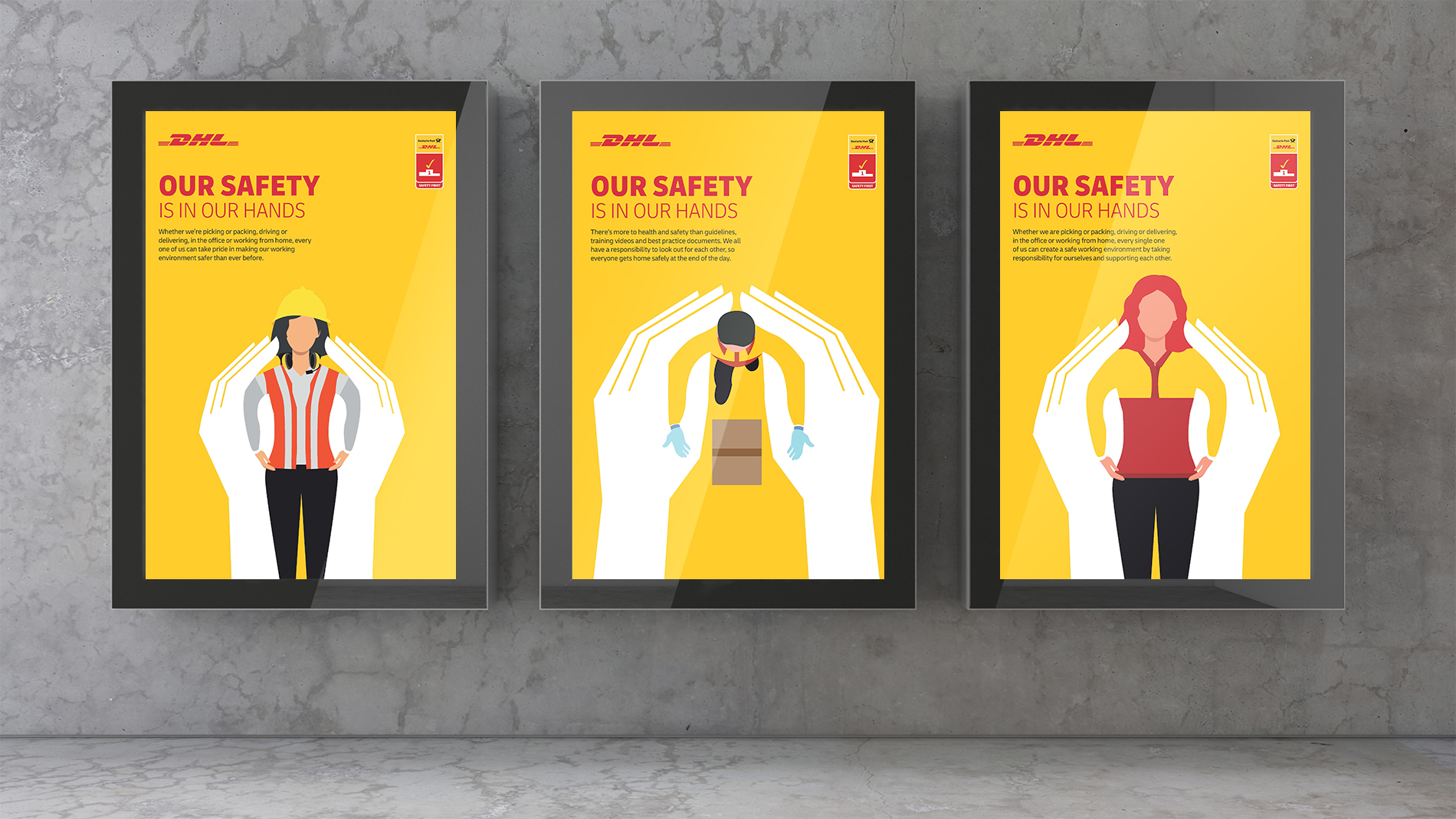
Importantly, the campaign was never intended as a single annual moment. While World Safety Day provided a useful focal point, the broader approach was always-on. Messages were broken into manageable themes and revisited throughout the year, with visual materials reinforcing conversations already taking place in team briefings and leadership discussions.
Local teams were encouraged to adapt the campaign in ways that made sense for their context. What felt engaging in one country might look different in another. That flexibility did not dilute the message; it strengthened its relevance.
Ownership and accountability
Across both case studies, ownership emerged as a defining factor. At DHL, the framing is explicit: safety sits in everyone’s hands. It is not confined to a function or a department. Managers, supervisors and frontline colleagues all play a role in holding standards and raising concerns.
At Biffa, drivers were positioned as professionals whose expertise shaped the training content itself. When people feel trusted and responsible, behaviour becomes more consistent. That is why messages that rely solely on instruction rarely create lasting commitment, whereas communication that reinforces identity and shared standards is more likely to endure.
Avoiding complacency
A question raised during the session was how to prevent complacency over time. How do you stop visual materials becoming part of the background?
The panel agreed that motivation alone is not enough. Habits are more powerful than short bursts of enthusiasm. Sustained behaviour change relies on repetition, visible leadership commitment and regular, meaningful conversation.
World Safety Day can act as a catalyst by creating a moment to pause and reflect. However, without consistent reinforcement throughout the year, the effect diminishes. Sally described this through a simple analogy: awareness days can act like fireworks, capturing attention briefly, but what sustains culture is the steady bonfire that keeps people gathered in conversation.
For those responsible for communicating health and safety, this means thinking beyond the launch moment. It involves equipping middle managers with the confidence and tools to lead discussions, investing visibly in frontline activation and ensuring that tone always reflects respect for the complexity and skill of the roles involved.
From campaign to culture
What emerged from this Work Wonders session was not a formula, but a mindset. Embedding safety requires more than creative assets or annual initiatives. It calls for communication that reflects how work is actually done, that builds ownership at every level and that remains present throughout the year rather than appearing only at designated moments.
For internal communicators and those responsible for health and safety messaging, the role extends beyond informing. It is about helping to shape shared expectations and everyday habits so that safe practice becomes part of professional identity.
If you are reviewing how safety is communicated across your organisation ahead of World Safety Day, we would welcome the opportunity to talk.
This session formed part of Work Wonders, our community for people shaping workplace culture, communication and inclusion. If you would like to join future conversations and connect with others navigating similar challenges, you can find out more about becoming part of the community.
Watch the session: Transforming safety culture in the workplace

HR is under pressure – and the pressure isn’t easing. Here’s how comms can help
By Sally Pritchett
CEO
The pressure on HR is rising. Strategic communication can help carry the weight.
There’s growing pressure in HR – and it’s not easing any time soon. 64% of HR professionals say they’re experiencing near-constant stress. Budgets are tight. Workloads keep growing. And the pace of change is relentless – legislative, cultural, technological. The HR function is stretched, often seen as a cost centre rather than a strategic driver, and yet still expected to hold the organisation together.
That reality came through clearly at a recent We Do Group event, where our CEO Sally joined a room full of passionate HR leaders to talk about change, culture and communication – and how the pressure on HR is rising, even as expectations grow.
We know that HR can rise to the challenge – with communication as a strong and strategic ally.
Change is happening – whether you’re ready or not
Change is already happening – the question is whether it’s happening to you or with you. And whether it’s planned or reactive, it always ends up at HR’s door.
Right now, leaders are being asked to guide people through uncharted territory – AI, instability, uncertainty. That calls for a different kind of leadership. Not just confident decision-makers, but emotionally intelligent, authentic ones. HR has a powerful role to play in helping those leaders listen better, connect more deeply, and create the safety their people need. But HR can’t do it alone.
That’s where communication comes in – as an expert partner in guiding people through change. While the destination might stay the same, how we get there will keep shifting. Comms helps teams stay connected to the golden thread of purpose and values along the way.
Done well, communication can unite rather than divide. It can shape trust, bring clarity and give people something solid to hold onto, even when the path is uncertain.
Repositioning HR: From compliance to culture
HR needs a rebrand. It’s still too often positioned as a back-office function – focused on policy, compliance and admin. But HR is culture and separating the two no longer makes sense. Every day, we see HR teams being asked to drive culture – to lead on engagement, inclusion, wellbeing and values – without always being given the recognition, resource or influence that should come with it.
If we’re serious about people and culture being a business priority, we have to start treating it like one. That means:
- Stop reporting on outputs. Start talking about impact.
- Don’t just ask for budget – show the cost of not investing in people and culture.
- Use storytelling to land what data alone can’t.
- Move the conversation on from hybrid vs office – and focus instead on proximity, connection and leadership that truly listens.
It also means tightening the loop between HR and internal comms. Because how you say things can be just as important as what you say – especially in moments of change.
People are listening – even when you think they’re not
In a hyper-connected world, everything you say internally can and will be seen externally. Employees are customers. Suppliers are stakeholders. Very few messages stay internal these days and that makes transparency non-negotiable.
If you only communicate when things are going well, you’ll lose trust when things aren’t. Hard news doesn’t damage trust – poor communication does. When it’s time for tough decisions like redundancy during difficult economic times, your people should have already been on the journey to understand the context, not hear it for the first time on the day of an announcement.
It’s much easier to get a message right the first time than to try and rebuild trust after it’s broken.
What HR needs now
The HR function looks different in every business – but the pressure is felt everywhere. Whether you’re flying the flag for culture in the boardroom or delivering the tactical day-to-day, you deserve better tools, stronger influence and genuine partnership.
Change is happening either to you or with you. The difference often comes down to whether comms is working with HR – or working in parallel.
At Something Big, we understand HR. We know the pressure you’re under – and the passion and potential that drives you. We’re here to support you with communication that’s commercially minded, consistent and comprehensive, right when you need it most. Let’s talk about your people and culture challenges – and how we can tackle them together.
If you work in HR and you’re looking for insight, connection and fresh thinking, you’re not alone. Our Work Wonders community is built for people like you – passionate about people and culture, and ready to share ideas, challenges and support. Join us and be part of a growing network of HR and comms professionals making change happen.