
By Sally Pritchett
CEO
The IC Index 2026 highlights clear gaps in the frontline communication experience. Here’s how organisations can start closing them.
The latest IC Index 2026 shows a consistently poorer communication experience for frontline employees than for their desk-based colleagues, with clear gaps in trust, leadership visibility, employee voice and manager communication.
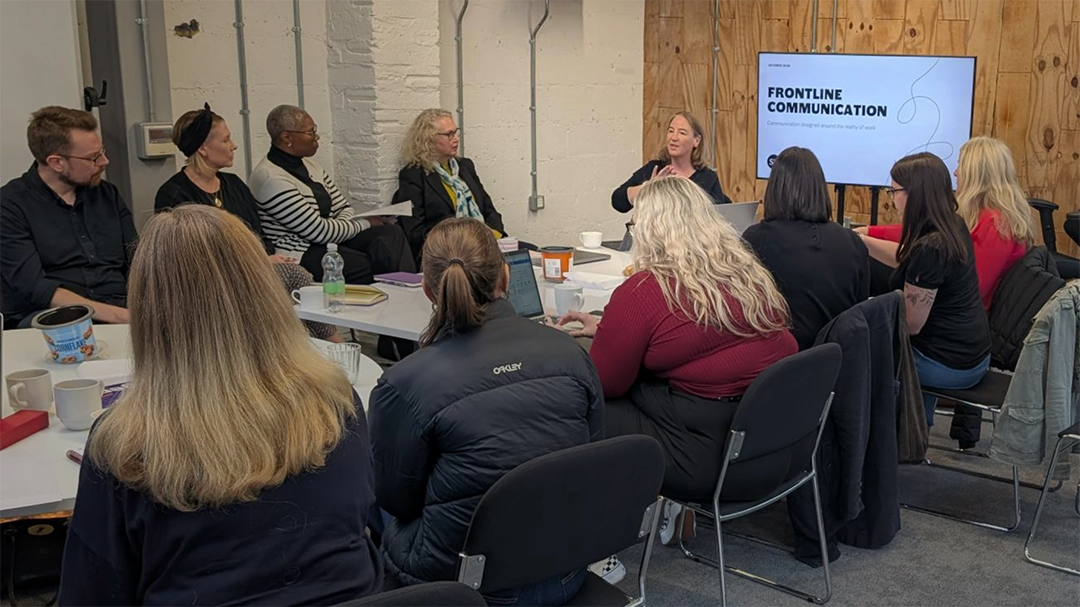
Those findings set the scene for a recent IOIC South session hosted at Something Big, where Jennifer Sproul, Chief Executive of the Institute of Internal Communication, Andrew Boatman, Client Growth Consultant at Gallagher, and our Co-founder Sally Pritchett explored what communicators can do in practice to start closing those gaps.
The leadership and trust gap
Frontline employees are much less likely to hear directly from senior leaders. According to the IC Index 2026, when major change happens just 18% of frontline workers typically hear it from their senior leadership team, compared with 39% of colleagues who work mostly at a computer. One in five frontline employees say they hear about big changes through word of mouth.
There’s a corresponding gap in trust. Just 35% of frontline employees say they trust their CEO or most senior leader, compared with 54% of desk-based colleagues.
One question raised during the discussion summed up the challenge neatly: how do you trust people you’ve never met?
Closing that gap doesn’t mean adding another CEO email or video to your comms plan. It means thinking about how leaders become more visible and connected to the reality of frontline work.
That might mean leaders spending more time on site, listening directly to employees or working more closely with local leaders who understand what is happening on the ground. The important step is to give frontline employees more opportunities to see, hear from and speak to the people leading the organisation.
The voice gap
There’s also a significant difference in how safe employees feel speaking up.
Only 39% of frontline employees say people can share their opinion without fear of negative consequences, compared with 52% of those mostly working at a computer.
Communication alone can’t create psychological safety, but it can help create an environment where people feel part of the conversation rather than simply on the receiving end of it.
Sally shared DHL’s global ‘I Belong’ campaign where what could have been a traditional corporate message became an invitation for employees to tell their own stories. Leaders helped get the conversation started, but colleagues were then given the freedom to make the idea their own.
The practical challenge is to create communication people can genuinely participate in, rather than adding another response mechanism to an otherwise one-way conversation.
The manager gap
Managers remain central to the frontline communication experience. They’re also under enormous pressure.
Around one in four managers in frontline settings spends less than 15 minutes a day communicating with their team. And only 53% of frontline employees say their manager does a good job of adapting communication to their team’s context, compared with 69% of desk-based colleagues.
The encouraging part of the research is that support makes a real difference.
Only 48% of managers given no communication support feel equipped to lead conversations with their teams. That rises to around 90% when managers are given training or dedicated time to prepare.
Yet the discussion also highlighted how complicated that role has become with managers often finding themselves caught between competing organisational priorities.
As one example raised in the discussion, they may be asked to help teams work faster because output is down, while also reinforcing the importance of working safely. At the same time, they are expected to explain change, keep people motivated and answer questions about decisions they did not make, often while managing operational pressures of their own.
The answer to this problem isn’t another lengthy cascade pack.
Andrew talked about equipping managers before broadcasting, while Sally encouraged us to think about managers as people, not communication channels. That means giving them time to understand the message, usable language for difficult conversations and somewhere to go when they don’t have the answer.
Bringing local leaders in earlier can help too. They often know what other messages teams are hearing and where priorities may conflict, which means they can help sequence communication before managers are left to make sense of it.
The good news gap
One of the more striking IC Index findings was about good news. Just 56% of frontline employees say their organisation communicates good news effectively, compared with 70% of desk-based employees.
For bad news, the difference almost disappears: 44% compared with 46%.
That raises a useful question: what does good news actually look like for your frontline?
That answer may look different in every organisation. It could include business success, but it might also be recognition for great work, a local achievement or seeing frontline employees properly represented in the organisation’s story.
Sally shared DHL Defenders, a security campaign that deliberately positioned frontline employees as part of the solution. Rather than focusing on mistakes people might make, the campaign reframed the message to recognise the important role they played in protecting the business.
The way we communicate can focus only on what we need frontline employees to do, or it can also recognise the value of what they already contribute. The step here is to understand what good news matters to your frontline, then make sure their contribution is visible within the success your organisation shares.
There’s no silver bullet, but there are plenty of places to start
No employee app, new channel or AI tool is going to suddenly close the frontline communication gap. Technology can play a useful role, but it can’t create trust, give an overloaded manager more capacity or make people feel heard on its own.
Look at the frontline communication experience in your organisation. Where is the biggest gap? It might be connection with leaders, employee voice, pressure on managers or whether frontline employees feel recognised and valued.
Then start there.
So, what step could you take today to start closing the gap?
Where is the frontline communication gap in your organisation?
We can help you understand where your frontline communication experience is falling short, identify the gaps that matter most and decide where practical action could make the biggest difference. Talk to us about finding and closing the gaps in your frontline communication.