

The serious impact of having fun
By Sally Pritchett
CEO
Why gamification could be a game-changer for internal behaviour change
Let’s start with a little pop quiz…
Question 1: What’s the name for using game mechanics in non-game situations to encourage engagement and influence behaviour?
- Playification
- Gamification
- Fun theory
- Gamer psychology
Question 2: Which of these could help employees practise decision-making?
- A board game involving risks and rewards.
- A card game full of real-life workplace dilemmas.
- A team challenge that tests their judgement.
- All of the above.
Question 3: What have you just done?
- Read some internal communications advice.
- Taken part in a quick game.
- Procrastinated for 30 seconds.
- Wondered where this is going.
The answers? B, D and B.
(Although we’ll also accept C or D for the last one. No judgement here.)
Just like that, you’ve experienced a little gamification. A few simple questions have hopefully sparked your curiosity, encouraged you to participate and given you a reason to keep reading. And that’s why gamification and game-based learning have a serious role to play in employee behaviour change.
The power of purposeful play
Gamification and game-based learning both draw on some powerful principles of behavioural science. While gamification adds elements like points, rewards and leaderboards to everyday activities, game-based learning uses games themselves to help people learn.
Both encourage active participation, making learning more engaging and easier to remember. They also tap into our natural curiosity and competitive nature, while creating a safe space to try new skills, learn from mistakes and explore different perspectives.
And there’s research to back it up. A recent review of 49 workplace studies found that gamification has the potential to improve employee motivation, engagement and knowledge retention (Uwakwe Udeh et al., 2025).
Of course, making something fun doesn’t automatically change behaviour. The magic happens when the experience is designed around what you actually want people to think, feel and do differently.
Let the games begin
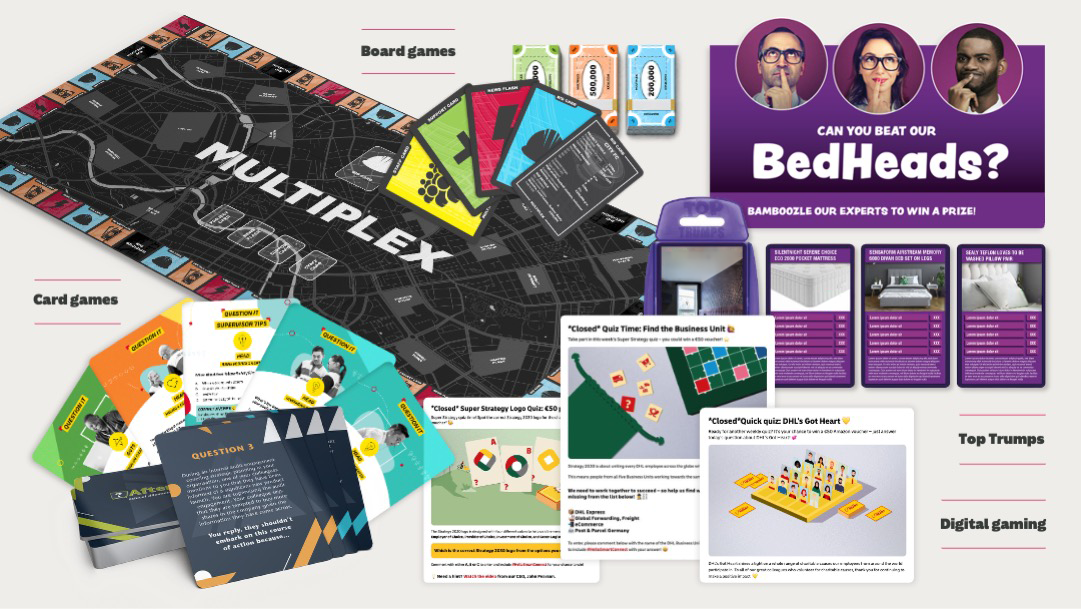
Whether you’re launching a new five-year business strategy, bringing company values to life or helping your teams grow their knowledge, gamification and game-based learning offer plenty of creative possibilities. And it doesn’t have to be expensive, complicated or even digital – sometimes the simplest ideas can have the biggest impact.
- Board games that bring decision-making to life. Imagine teams navigating business challenges, bidding for resources and taking calculated risks. If your strategy prioritises both innovation and customer satisfaction, would you trial an untested idea or stick with a proven approach? Every choice influences what happens next, making board games a creative way to explore business strategy, develop leadership skills or practise thinking on your feet.
- Card games that challenge employees to beat the experts. How much do colleagues really know about cybersecurity, sustainability or company products and service? Pitch them against subject matter experts in a battle of knowledge and give everyone a reason to brush up on the facts.
- Dilemma games that spark debate. How would you handle a difficult customer interaction, a logistics challenge or a workplace safety concern? Scenario-based games encourage colleagues to explore different viewpoints and debate tricky workplace decisions and trade-offs.
- Games that make behaviours memorable. Think charades, multiple-choice questions or describing an attribute without naming it. More engaging than memorising a list of company values, and a great way to get colleagues thinking about what those behaviours look like in practice. For example, acting out active listening could help managers understand how to make colleagues feel heard and supported.
- Weekly quizzes that keep people coming back. A little friendly competition can give employees a reason to visit your app or internal channels regularly. When aligned with your internal communications calendar, fresh topics, regional leaderboards and occasional prizes can help keep organisational priorities front of mind.
Play anywhere, remember everywhere
Games are particularly effective for reaching frontline teams. A pack of cards in a break room or a quick challenge between shifts can get colleagues involved without needing a laptop or login. Add some creative branding and you’ve got an employee experience that’s uniquely yours.
They’re also particularly valuable for onboarding, helping new starters quickly get under the skin of the business and build connections with their colleagues.
And shared experiences are far more memorable. Employees might forget a values presentation, but they’ll remember the hilarious charades performance or the dilemma that divided the room. Those conversations can continue long after the game is packed away.
More than just a game
The real opportunity isn’t simply to make internal communications more entertaining. It’s to create the kind of immersive employee experiences that money can’t buy through traditional communications alone. Because when the lessons go beyond the game and make a difference in everyday working life, everyone’s a winner.
Get in touch to explore how a more playful approach to internal communications can help you engage your people and support behaviour change.


7 ways People & Culture teams can make the most of awareness days
By Sally Pritchett
CEO
With so many awareness days, weeks and months to choose from, how do you make sure the ones you mark reflect your people and culture, and lead to something meaningful that lasts?
From diversity and inclusion to wellbeing, sustainability and workplace safety, there are hundreds of awareness days and campaigns throughout the year.
For People & Culture teams, these occasions can offer opportunities to engage colleagues on issues that affect their working lives, encourage learning and strengthen workplace culture.
But with so many dates competing for attention, how do you approach them thoughtfully, make sure different communities and issues are represented fairly and create an impact that lasts beyond the day itself?
Here are seven ways to make more of your awareness day communications.
1. Be strategic about what you mark and why
Trying to recognise every awareness day will leave teams stretched and communications feeling rushed or repetitive.
Think about how your calendar reflects your people, your workplace culture and your organisation’s priorities and challenges. Consider which communities and issues are being represented, whose experiences might be overlooked and where you have opportunities to make a difference.
Aim for a balanced calendar that gives the occasions you do mark the time and attention they deserve, rather than trying to do everything.
2. Involve the people closest to the conversation
If you’re planning activity around a particular community or experience, involve people who understand it first-hand.
Employee resource groups, colleagues with lived experience and subject matter experts can help make your communications more relevant and representative.
Involve people with relevant experience or expertise in the planning process, rather than simply asking for feedback once everything has been decided. And remember, nobody should feel pressured to share personal experiences.
3. Bring different teams into the conversation
Many awareness days cut across several areas of your organisation, from HR and internal communications to sustainability, inclusion and health and safety.
Bring relevant teams together to share expertise, coordinate activity and connect messages to wider initiatives.
This can help avoid conflicting messages or competing campaigns, while making sure your communications reach colleagues across different roles and working environments.
4. Make sure your words match your actions
Awareness day communications can quickly feel tokenistic when they don’t reflect what employees experience throughout the year. Before celebrating your organisation’s commitment to inclusion, wellbeing or sustainability, consider what you’re already doing to support it.
Share genuine progress, highlight existing initiatives and be open about areas where there’s still work to do. Employees are more likely to trust communications that reflect reality.
5. Match your tone to the topic
Not every awareness day calls for the same approach. Some are opportunities to celebrate, while others invite reflection or learning.
Think carefully about your language, imagery and messaging, considering how they might be received by colleagues with different experiences.
Avoid making assumptions about how people feel, be sensitive when sharing personal stories and use content warnings where appropriate. Give colleagues space to engage in ways that feel comfortable for them.
6. Help people take the next step
Raising awareness is a good starting point, but what happens once you’ve got people’s attention?
Think about how your communications could build understanding or encourage action. This might mean sharing practical guides, creating opportunities to learn, signposting relevant support or helping colleagues understand what they can do differently.
Keep things manageable. Give people the information and opportunities they need without overwhelming them with too much at once.
7. Keep the conversation going
An awareness day can start an important conversation, but lasting change takes longer.
Look for ways to reinforce messages through regular communications, learning opportunities and everyday workplace conversations.
Share progress, celebrate improvements and listen to how colleagues are responding. Use awareness days to build momentum around the things your organisation wants to improve throughout the year.
Explore our 2027 awareness calendars
Planning your awareness day activity for 2027? Our five free downloadable calendars bring together key UK and international awareness dates to help you identify opportunities that are relevant to your people and workplace priorities.
Use them as a starting point for building a balanced awareness calendar that reflects your workforce and supports your wider People & Culture plans.
Planning your 2027 awareness day activity? Get in touch to see how we can support you.