

Closing the frontline communication gap, one step at a time
By Sally Pritchett
CEO
The IC Index 2026 highlights clear gaps in the frontline communication experience. Here’s how organisations can start closing them.
The latest IC Index 2026 shows a consistently poorer communication experience for frontline employees than for their desk-based colleagues, with clear gaps in trust, leadership visibility, employee voice and manager communication.
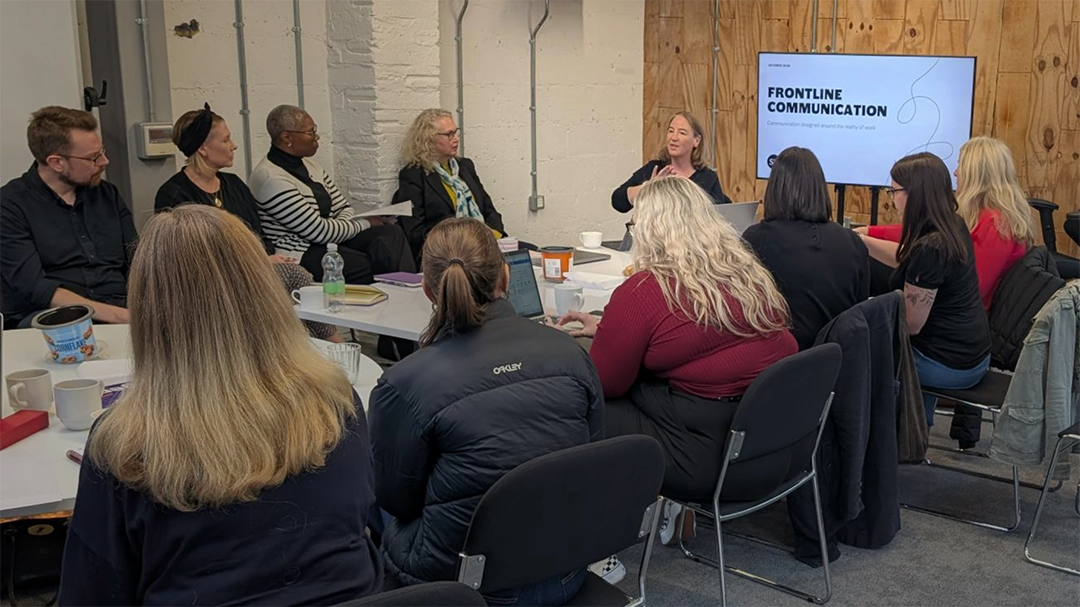
Those findings set the scene for a recent IOIC South session hosted at Something Big, where Jennifer Sproul, Chief Executive of the Institute of Internal Communication, Andrew Boatman, Client Growth Consultant at Gallagher, and our Co-founder Sally Pritchett explored what communicators can do in practice to start closing those gaps.
The leadership and trust gap
Frontline employees are much less likely to hear directly from senior leaders. According to the IC Index 2026, when major change happens just 18% of frontline workers typically hear it from their senior leadership team, compared with 39% of colleagues who work mostly at a computer. One in five frontline employees say they hear about big changes through word of mouth.
There’s a corresponding gap in trust. Just 35% of frontline employees say they trust their CEO or most senior leader, compared with 54% of desk-based colleagues.
One question raised during the discussion summed up the challenge neatly: how do you trust people you’ve never met?
Closing that gap doesn’t mean adding another CEO email or video to your comms plan. It means thinking about how leaders become more visible and connected to the reality of frontline work.
That might mean leaders spending more time on site, listening directly to employees or working more closely with local leaders who understand what is happening on the ground. The important step is to give frontline employees more opportunities to see, hear from and speak to the people leading the organisation.
The voice gap
There’s also a significant difference in how safe employees feel speaking up.
Only 39% of frontline employees say people can share their opinion without fear of negative consequences, compared with 52% of those mostly working at a computer.
Communication alone can’t create psychological safety, but it can help create an environment where people feel part of the conversation rather than simply on the receiving end of it.
Sally shared DHL’s global ‘I Belong’ campaign where what could have been a traditional corporate message became an invitation for employees to tell their own stories. Leaders helped get the conversation started, but colleagues were then given the freedom to make the idea their own.
The practical challenge is to create communication people can genuinely participate in, rather than adding another response mechanism to an otherwise one-way conversation.
The manager gap
Managers remain central to the frontline communication experience. They’re also under enormous pressure.
Around one in four managers in frontline settings spends less than 15 minutes a day communicating with their team. And only 53% of frontline employees say their manager does a good job of adapting communication to their team’s context, compared with 69% of desk-based colleagues.
The encouraging part of the research is that support makes a real difference.
Only 48% of managers given no communication support feel equipped to lead conversations with their teams. That rises to around 90% when managers are given training or dedicated time to prepare.
Yet the discussion also highlighted how complicated that role has become with managers often finding themselves caught between competing organisational priorities.
As one example raised in the discussion, they may be asked to help teams work faster because output is down, while also reinforcing the importance of working safely. At the same time, they are expected to explain change, keep people motivated and answer questions about decisions they did not make, often while managing operational pressures of their own.
The answer to this problem isn’t another lengthy cascade pack.
Andrew talked about equipping managers before broadcasting, while Sally encouraged us to think about managers as people, not communication channels. That means giving them time to understand the message, usable language for difficult conversations and somewhere to go when they don’t have the answer.
Bringing local leaders in earlier can help too. They often know what other messages teams are hearing and where priorities may conflict, which means they can help sequence communication before managers are left to make sense of it.
The good news gap
One of the more striking IC Index findings was about good news. Just 56% of frontline employees say their organisation communicates good news effectively, compared with 70% of desk-based employees.
For bad news, the difference almost disappears: 44% compared with 46%.
That raises a useful question: what does good news actually look like for your frontline?
That answer may look different in every organisation. It could include business success, but it might also be recognition for great work, a local achievement or seeing frontline employees properly represented in the organisation’s story.
Sally shared DHL Defenders, a security campaign that deliberately positioned frontline employees as part of the solution. Rather than focusing on mistakes people might make, the campaign reframed the message to recognise the important role they played in protecting the business.
The way we communicate can focus only on what we need frontline employees to do, or it can also recognise the value of what they already contribute. The step here is to understand what good news matters to your frontline, then make sure their contribution is visible within the success your organisation shares.
There’s no silver bullet, but there are plenty of places to start
No employee app, new channel or AI tool is going to suddenly close the frontline communication gap. Technology can play a useful role, but it can’t create trust, give an overloaded manager more capacity or make people feel heard on its own.
Look at the frontline communication experience in your organisation. Where is the biggest gap? It might be connection with leaders, employee voice, pressure on managers or whether frontline employees feel recognised and valued.
Then start there.
So, what step could you take today to start closing the gap?
Where is the frontline communication gap in your organisation?
We can help you understand where your frontline communication experience is falling short, identify the gaps that matter most and decide where practical action could make the biggest difference. Talk to us about finding and closing the gaps in your frontline communication.


Diversity and Inclusion Calendar 2027
By Sally Pritchett
CEO
Free downloadable calendar of key UK diversity and inclusion awareness days 2027
Plan ahead with our free Diversity and Inclusion Calendar 2027, featuring key UK and international awareness days, religious and cultural celebrations and important dates for workplace inclusion.
Creating a workplace where everyone feels respected, valued and included takes ongoing commitment. Our downloadable calendar brings together important diversity, equity and inclusion (DEI) dates in one place, helping HR, internal communications and inclusion teams plan activities, recognise occasions that matter to their people and create opportunities for meaningful conversations throughout the year.
What’s included in our 2027 Diversity and Inclusion Calendar?
- Key UK and international diversity and inclusion awareness days, weeks and months
- Cultural and religious celebrations
- Important dates covering race, gender, age, disability, neurodiversity and LGBTQ+ inclusion
Whether you’re planning your annual internal communications calendar, organising employee engagement activities or developing your inclusion programme, this free PDF is a useful starting point.
Make awareness days part of your wider inclusion plans
Awareness days can be a useful starting point for conversations about inclusion, but lasting progress takes work throughout the year.
If you’re reviewing your approach to workplace inclusion, try our Inclusion Diagnostic or explore how we partnered with DHL Group on its I Belong inclusion and belonging campaign.
Looking for support with your inclusion communications? Get in touch to see how we can help.
Explore our other 2027 awareness calendars
Planning your workplace communications for the year ahead? Explore our free Employee Wellbeing, Sustainability and Environmental Awareness, Productivity & Digital Skills and Workplace Safety calendars.
Download your free Diversity and Inclusion Calendar 2027

Sustainability and Environmental Awareness Calendar 2027
By Sally Pritchett
CEO
Free downloadable calendar of key sustainability and environmental awareness days 2027.
Plan ahead with our free Sustainability and Environmental Awareness Calendar 2027, featuring key UK and international awareness days, weeks and events focused on the environment and sustainability.
Keeping sustainability on the workplace agenda takes ongoing effort. Our downloadable calendar brings together important environmental dates in one place, helping sustainability, ESG, HR and internal communications teams plan activities, raise awareness of environmental issues and engage employees throughout the year.
What’s included in our 2027 Sustainability and Environmental Awareness Calendar?
- Key UK and international environmental awareness days, weeks and months
- Important dates covering climate action, biodiversity, conservation, recycling and waste reduction
- Events and campaigns focused on sustainable living, responsible consumption and protecting the natural environment
Whether you’re planning your annual internal communications calendar, organising employee sustainability activities or looking for opportunities to communicate your organisation’s environmental commitments, this free PDF is a useful starting point.
Keep sustainability part of the conversation
Environmental awareness days offer opportunities to engage employees with important issues, share progress and connect sustainability commitments to everyday actions.
If you’re looking to strengthen how you communicate your organisation’s environmental goals and progress, explore our guide to building confidence in sustainability communications.
We also help sustainability and ESG teams turn complex information into engaging, accessible sustainability reports. From expert reviews of existing reports to full report creation, get in touch to find out how we can help.
Explore our other 2027 awareness calendars
Planning your workplace communications for the year ahead? Explore our free Diversity and Inclusion Calendar, Employee Wellbeing Calendar, Digital Skills & Productivity Calendar and Workplace Safety Calendar.
Download your free Sustainability and Environmental Awareness Calendar 2027

Employee Wellbeing Awareness Calendar 2027
By Sally Pritchett
CEO
Free downloadable calendar of key UK employee wellbeing awareness days 2027.
Free UK employee wellbeing awareness days calendar
Plan ahead with our free Employee Wellbeing Calendar 2027, featuring key UK and international health and wellbeing awareness days, weeks and months to support your workplace wellbeing activities throughout the year.
Supporting employee health and wellbeing takes ongoing commitment. Our downloadable calendar brings together important dates in one place, helping HR, internal communications and wellbeing teams plan activities, raise awareness of important health issues and start meaningful conversations with employees.
What’s included in our 2027 Employee Wellbeing Calendar?
- Key UK and international health and wellbeing awareness days, weeks and months
- Important mental health dates, including Time to Talk Day, Mental Health Awareness Week and World Mental Health Day
- Awareness dates covering physical health, nutrition, workplace wellbeing and specific health conditions
Whether you’re planning your annual internal communications calendar, organising employee wellbeing activities or developing your workplace wellbeing programme, this free PDF is a useful starting point.
Make employee wellbeing part of your workplace culture
Awareness days can help start important conversations about health and wellbeing, but supporting employees takes consistent effort throughout the year.
Explore our guide to building a culture of wellbeing through communication for practical advice on how communication can support a healthier workplace.
Looking for support with your employee wellbeing communications? Get in touch to see how we can help.
Explore our other 2027 awareness calendars
Planning your workplace communications for the year ahead? Explore our free Diversity and Inclusion, Sustainability and Environmental Awareness, Productivity & Digital Skills and Workplace Safety calendars.
Download your free Employee Wellbeing Calendar 2027

Workplace Safety Calendar 2027
By Sally Pritchett
CEO
Free downloadable calendar of key workplace health and safety awareness days 2027.
Plan ahead with our free Workplace Safety Calendar 2027, featuring key UK and international health and safety awareness days, weeks and months to support your workplace safety communications throughout the year.
Keeping people safe at work takes ongoing attention. From construction sites and warehouses to offices and other workplaces, regular communication helps employees understand risks, recognise safe working practices and know where to find support. Our downloadable calendar brings together important health and safety dates in one place, helping HR, health and safety and internal communications teams plan campaigns and keep safety on the agenda.
What’s included in our 2027 Workplace Safety Calendar?
- Key UK and international workplace health and safety awareness days and weeks
- Important dates covering occupational health, fire safety, gas safety, first aid and road safety
- Awareness events focused on mental health, stress and physical wellbeing at work
Whether you’re planning your annual health and safety communications calendar, organising workplace safety campaigns or looking for opportunities to engage frontline and operational teams, this free PDF is a useful starting point.
Make safety part of everyday working life
Awareness days offer opportunities to highlight important risks, reinforce safe working practices and encourage conversations about health and safety.
But reaching employees with important safety messages can be challenging, particularly across shifts, sites and frontline roles.
Explore how we partnered with DHL Supply Chain to turn safety into everyday behaviour.
We also help organisations strengthen frontline communication, making sure important information reaches the people who need it. Get in touch to see how we can help.
Explore our other 2027 awareness calendars
Planning your workplace communications for the year ahead? Explore our free Employee Wellbeing Calendar, Diversity and Inclusion Calendar, Sustainability and Environmental Awareness Calendar and Digital Skills & Productivity Calendar.
Download your free Workplace Safety Calendar 2027

Productivity & Digital Skills Calendar 2027
By Sally Pritchett
CEO
Free downloadable calendar of key digital skills, technology and productivity awareness days 2027.
Plan ahead with our free Productivity and Digital Skills Calendar 2027, featuring key UK and international awareness days focused on digital learning, technology, innovation and productivity in the workplace.
As AI, automation and digital technologies continue to change how we work, helping employees develop their skills and adapt to change is increasingly important. Our downloadable calendar brings together relevant dates in one place, helping HR, internal communications, learning and development and digital transformation teams plan activities, share knowledge and encourage conversations about the changing world of work.
What’s included in our 2027 Productivity and Digital Skills Calendar?
- Key UK and international digital skills, technology and productivity awareness days
- Important dates covering AI, cyber security, digital learning and innovation
- Events celebrating workplace learning, skills development and the role of technology in everyday working life
Whether you’re planning your annual internal communications calendar, organising digital skills initiatives or looking for opportunities to engage employees with new technologies, this free PDF is a useful starting point.
Help employees navigate workplace change
New technologies and changing ways of working can create uncertainty for employees, particularly when the pace of change is high.
Good communication helps people understand what’s changing, why it matters and what it means for their roles.
At Something Big, we help organisations communicate change in ways that build understanding and confidence. From supporting digital transformation programmes to helping leaders communicate through uncertainty, we work with teams to make complex changes easier to understand. Get in touch to see how we can help.
Explore our other 2027 awareness calendars
Planning your workplace communications for the year ahead? Explore our free Diversity and Inclusion Calendar, Employee Wellbeing Calendar, Sustainability & Environmental Awareness Calendar and Workplace Safety Calendar.
Download your free Productivity and Digital Skills Calendar 2027

Think you have a frontline communications problem? It might be starting at head office.
By Sally Pritchett
CEO
Explore how to reduce frontline communication overload by joining up priorities, protecting employees' time and making messages count.
Frontline employees aren’t inherently hard to reach. Often, the problem is communication designed around desk-based ways of working.
But designing communication for the frontline is only part of the answer.
Because even the best-designed communication will struggle to land if it’s competing against multiple other messages for the same few minutes of attention.
Corporate news. Regional updates. Functional priorities. HR campaigns. Safety messages. IT updates. Leadership asks. Each one might be perfectly reasonable in isolation. But together, they can become noise.
So where does the frontline communication problem begin? Sometimes, it starts at head office.
Frontline employees don’t see your organisational chart
One of the challenges in large organisations is that communication tends to follow the structure of the business.
Corporate has something to say. A region has something else. Then HR, operations, IT, safety and individual functions all have their own priorities.
From inside those teams, each message feels important.
But the frontline employee on the receiving end doesn’t experience those messages as separate workstreams. They simply experience more communication.
And they have very little time to give it.
The IC Index 2026 found that most employees spend 10 minutes or less each day to engage with organisational communication, while one in five say they have no or hardly any time at all.
That should fundamentally change the way we think about what we ask people to read, watch, absorb and act on.
Because the question can’t simply be: “Is this message important enough to share?” It also needs to be: “Is it important enough to take up some of those ten minutes?”
Every message can’t be the priority
Communication overload rarely happens because somebody deliberately decides to overwhelm employees. It happens because every part of the organisation is looking at its own priorities.
The strategy update is important to the leadership team. The new people initiative matters to HR.
The system change matters to IT. The operational campaign matters to the region.
Everyone has a legitimate reason to communicate.
The problem comes when nobody is looking at the total experience of the employee receiving it all. If five teams independently decide their message is a priority, the frontline employee doesn’t receive five priorities. They receive competition.
And when everything is urgent, important and worthy of attention, it becomes much harder to work out what actually matters now.
That’s why frontline communication needs a gatekeeper.
Who is protecting the frontline’s attention?
By “gatekeeper”, we don’t mean one person standing between head office and the frontline with a giant red pen. It could be a communications team, an editorial process, a planning forum or a clear set of principles.
What matters is that somebody is looking across the organisation and asking:
- What does this audience genuinely need from us right now?
- What do they need to know, understand or do?
- What can be combined with something else?
- And what can wait?
That last question is important.
Internal communicators often spend a lot of time helping organisations communicate more. Sometimes our most valuable role is helping them communicate less, better.
Join the dots before the message reaches them
Reducing overload doesn’t necessarily mean important information disappears. It means doing more work before it reaches the employee.
Imagine someone receives one message about company strategy, another about regional priorities and another about what their function needs to deliver this quarter.
Organisationally, those may have three different owners. But do they need to be three different stories? Could they become one: Here’s where we’re going. Here’s what that means for our region. And here’s what we need you to focus on now.
That is the work of simplifying and combining narratives.
Because employees shouldn’t have to join the dots between corporate, regional, functional and local messages – especially with only 10 minutes to pay attention. The gatekeeper should join the dots before the message gets to them.
Earning the frontline’s attention
We know frontline environments are busy. Messages aren’t just competing with other communications, but also with customers, equipment, deadlines, safety requirements, colleagues and the task at hand in the moment.
Once we’ve determined what deserves attention, the next challenge is how to make it worth noticing. Being given space in the communications plan doesn’t guarantee anyone will pay attention.
This is where creativity matters.
That doesn’t necessarily mean making a message bigger or louder. It might mean a strong creative idea that makes the message easier to notice, understand and remember.
Making an employee app launch worth frontline attention
When DHL Express launched its Smart Connect employee app, it needed to reach 120,000 colleagues across 220 countries, many working on the frontline with limited access to traditional communication channels.
With a previous app experiencing low uptake, another corporate announcement wasn’t going to be enough.
We focused the launch campaign on what mattered to employees: finding information quickly, staying informed and connecting with colleagues. Distinctive illustrations helped the message stand out, while QR-enabled posters made it easy for frontline teams to access and download the app.
By making the benefits immediately relevant and easy to understand, the campaign helped drive more than 67,000 downloads in the first month, giving more colleagues a way to stay connected.
The frontline communication problem doesn’t always start with the frontline. So before asking how to get a message to cut through, first ask whether it deserves a share of their attention at all.
Protect the audience’s time. Join the dots for them. And when something really does matter, make it worth noticing.
Are competing messages making it harder to reach your frontline?
We help organisations bring together competing communication priorities, simplify complex messages and create campaigns that connect with frontline employees in the reality of their working day.
Explore our frontline communications expertise or get in touch to talk about the challenges you’re facing.

How to reach frontline employees. Spoiler alert: it’s not that hard.
By Sally Pritchett
CEO
Frontline employees aren't inherently hard to reach. The challenge is designing communication around how they actually work.
Saying frontline employees are “hard to reach” no longer washes. Too often, “hard to reach” becomes shorthand for communication that has been designed around office-based ways of working. Frontline employees aren’t inherently hard to reach; they’re hard to reach through communication created for people who sit at desks, check emails throughout the day and have regular access to an intranet.
The problem therefore isn’t necessarily reach, or channels. It’s a design problem.
Asking the wrong question creates the wrong solution
Instead of asking, “How do we get this message to frontline employees?”, reframe the question to, “How do we design this communication around the reality of their working day?”
That distinction matters.
One in five frontline workers say they hear about major organisational change through the grapevine rather than directly from leaders. Trust in executive leadership sits at just 35% among frontline employees, compared with 54% among desk-based colleagues. And frontline workers are more than twice as likely to say they spend no time reading communication updates.
It would be easy to look at that final statistic and conclude that frontline employees simply aren’t engaging.
But there’s a much more useful question to ask: Do they genuinely have the time, access or reason to pay attention in the first place?
Because too much organisational communication still starts with the same assumptions: that people have a work email address, regular access to a screen, time to read during office hours, a relatively quiet environment and scheduled opportunities to hear from leaders. For millions of frontline employees, none of those things can be taken for granted.
They may be working shifts, moving between locations, operating equipment, supporting customers or delivering time-critical services. They may technically have access to a platform, but no realistic opportunity to use it.
So when communication is designed around desk-based assumptions, frontline colleagues are left to do the adapting. They have to find the message, work out whether it’s relevant, translate the corporate language into what it actually means for them, and somehow fit all of that around their working day.
Start with the person, place and pressure
One reason frontline communication can feel difficult is that the word “frontline” hides an enormous amount of variation.
A cabin crew member, engineer, care worker, warehouse colleague and station team member might all be described as frontline. But their working realities are completely different. They face different pressures, work in different environments and have very different opportunities to access communication.
So before thinking about channels, first consider the person.
What do they already know? What does their role involve? What language do they use? How familiar are they with the subject? And what access to communication do they genuinely have?
Then, the place.
Where will they encounter the communication? On a shift? At a site? In a vehicle? In a customer-facing environment? At home between shifts?
And finally, pressure.
What else is demanding their attention at that moment? Safety? A customer? An operational deadline? Noise? A dozen other messages competing for attention?
That’s what should influence the communication before the channel or creative execution is decided. When communication is built around the realities of a distributed workforce, the audience suddenly becomes a lot less “hard to reach”.
Reaching the frontline, where they are
“One of my favourite frontline projects was a strategy launch for Yodel. The brief was simple: understanding of the strategy couldn’t stop at manager level. It had to reach the frontline too. Mission accepted.”
Sally Pritchett, CEO, Something Big
When Yodel asked us to launch its new strategy across the frontline, the first step was understanding how people actually worked.
At the time, its frontline workforce included around 11,000 employed colleagues, agency workers and self-employed or contracted drivers and couriers, spread across the UK. Many spent limited time in hubs or service centres and there was no single digital channel that could reliably reach everyone.
So rather than trying to force a digital solution, we looked for something people already had in common: regular team briefings.
We created a physical, visually led session aid that managers and supervisors could use to run a short strategy briefing wherever their teams happened to be, from a rest room to a corner of a warehouse.
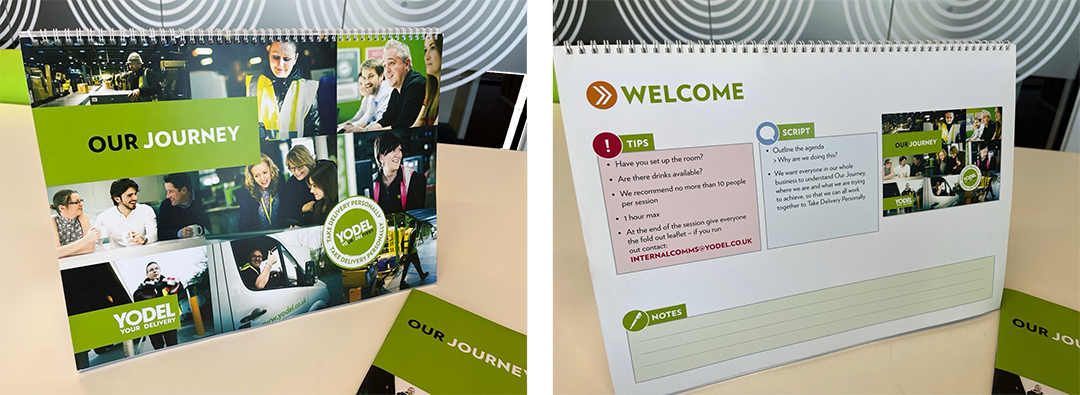
The session required no advance preparation. The aid included a simple script, questions to prompt discussion and guidance to help managers respond. It was designed to be practical, robust enough for an operational environment and, most importantly, easy to use.
We also tested it with frontline teams before launch, making sure the content made sense, felt relevant and spoke to people with the respect their roles deserved.
The result was strong reach across the workforce, exceeding our targets. Pre and post-session surveys also showed a measurable increase in understanding of the strategy.
Create communications for notice, understanding and action
Once you understand the person, place and pressure, the next question is whether the communication has been created to work in that reality.
Start with three simple tests:
Will they notice it?
Not just: Have we sent it or published it? But will it actually show up somewhere that makes sense in the flow of their day?
That might be a shift handover. A safety huddle or toolbox talk. A break area. A digital screen. A manager conversation. A one-page prompt.
None of these are especially exciting new communication channels. That’s partly the point.
Instead of constantly asking employees to go somewhere else for communication, we can take communication into moments that already exist. Fit the message into the rhythm of work, rather than adding another task to the working day.
Will they understand it?
Frontline employees shouldn’t have to decode corporate language or work out for themselves why something matters.
The message needs to be clear, relevant and easy to grasp quickly. What’s changing? Why does it matter? And what does it mean for me, in my role?
Can they act on it?
There’s little value in asking someone to do something if the realities of their working day make it difficult or impossible.
So the final test is whether the communication leads to an action that is realistic in the context of the role, the environment and the pressures they are working under.
Design for the frontline, not the desktop
Frontline employees aren’t hard to reach because they work differently from office-based colleagues. They become hard to reach when communication asks them to adapt to a system that wasn’t designed around them.
So, the next time we describe an audience as “hard to reach”, perhaps we should look at the communication first.
Because if we understand the person, the place and the pressure – and design around what they need to notice, understand and act on – reaching them might not be the hard part after all.

How can charities unlock more value from their impact report?
By Sally Pritchett
CEO
Five practical ways to get more from your charity impact reporting - making the story more meaningful, encouraging action and extending its value beyond publication.
Charities put a huge amount of work into impact reports. There is data to gather, stories to find, stakeholders to consult and approvals to work through before you even get to shaping the story, developing the key messages, writing the content and designing the final report.
Then it gets published, shared for a few weeks and, all too often, left there.
That means much of the report’s potential can go unused. A strong impact report can help people understand the difference your charity makes, build confidence in your organisation and encourage supporters, funders and partners to engage further. It can also create a valuable bank of stories, evidence and creative assets that keeps working long after publication.
We explored this topic during the B Corp Agency Alliance Charity Support Sessions, a free virtual event bringing together specialist B Corp agencies to share practical support with charities and not-for-profits. As part of the morning, our Commercial Director Felicity Allen and Creative Nikki James shared five ways charities can unlock more value from their impact reports.
1. Focus on the difference you made, not just what you did
It is easy for an impact report to become just a record of activity. We launched this, we delivered that, we supported this many people, we raised this much money.
Those facts matter because they show the scale of the work and give readers evidence of what has happened. But they do not always answer the question people really care about: what difference did it all make?
One example Felicity and Nikki explored throughout the session was an impact report we created for Autism Unlimited.
Alongside the important headline figures, the report featured stories from service users, including Max, whose experience showed how Autism Unlimited had helped him build a more independent future. The figures showed the scale of the charity’s work. Max’s story showed the difference behind them.
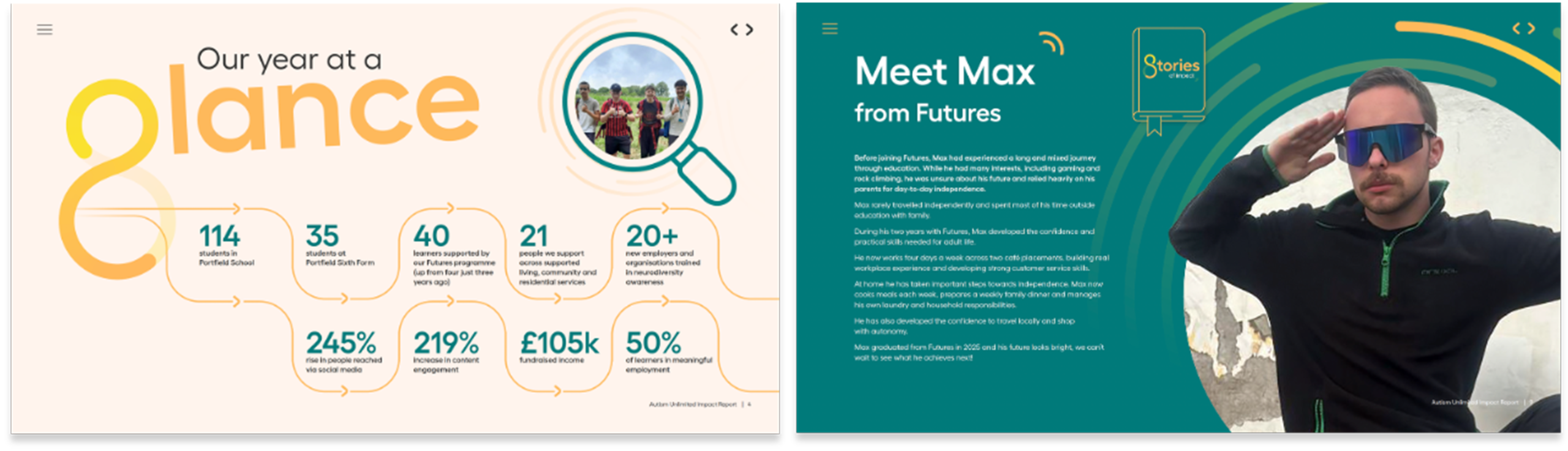
That is a useful balance to aim for throughout an impact report. Use the data to demonstrate reach and progress, then use people’s stories to show what those numbers mean in real life.
2. Use transparency to build trust
An impact report should absolutely celebrate what has gone well. That doesn’t mean every target needs to look like it was hit or every project needs to have gone exactly to plan. For charities asking donors, supporters, trustees and funders to place trust in the organisation, being open about where things didn’t go to plan and what you have learned from that can make the story more credible.
When we created our own impact report at Something Big, for example, we included a section focused on what we had learned during the year. We used a simple ‘We said, we did, we learnt’ approach, giving the learning the same prominence as the progress rather than hiding it in a footnote at the back.
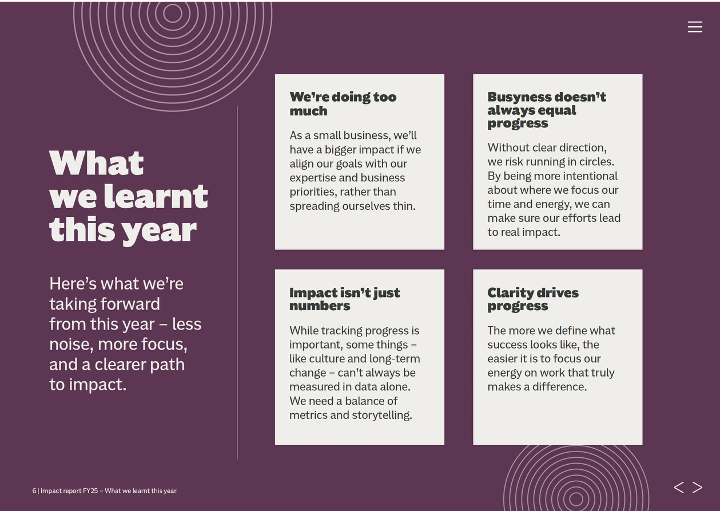
You might acknowledge where a target was missed, explain what changed along the way or show how an experience will influence what you do next. It gives readers a more rounded picture of progress and shows how the organisation is learning and responding.
3. Make the important things easy to understand
Impact reports need to communicate a lot, from financial information and programme updates to statistics, case studies and evidence of progress. Without a clear hierarchy, it can be difficult for readers to know what matters most. Good impact report design should guide readers towards the information you really want them to take away.
Most readers will skim rather than work through every page word for word, so the design needs to help them find the important parts quickly. In practice, that could be as simple as turning a dense table into a clear chart, pulling out one meaningful statistic rather than giving twelve equal weight or giving an important story more room on the page. Every design choice should make the information easier to understand.
Accessibility should be part of this thinking from the start too, helping make the report easier for everyone to understand and navigate.
4. Give people somewhere useful to go next
If a section of your report makes someone want to know more or get involved, what do you want them to do next?
The next step might be making a donation, finding out more about a service, becoming a volunteer, starting a partnership conversation or sharing your work with somebody else. Thinking about this early makes it easier to build natural next steps into the report.
You do not need to fill every page with buttons and donation prompts. The best calls to action make sense in the context of what someone has just read. If a story will make someone want to know more, give them a clear route to continue exploring it. If a section has shown what a particular programme achieved, that may be a natural moment to explain how people can support or get involved.
The aim is to avoid creating a dead end just as you have earned somebody’s attention.
5. Extend the impact beyond launch
By the time you have created an impact report, you have often created one of the richest banks of content your charity has. There are stories, quotes, statistics, photographs, evidence of change and examples of what funding has made possible. All of that can continue to work elsewhere.
A strong case study might become a story for your website, social content or part of a presentation to a potential funder. A useful statistic might strengthen an email to supporters, a funding presentation or future fundraising communications. Quotes and photography can continue to tell the story of your work throughout the year and beyond.
Think about reuse while you are creating the report, rather than once it is finished. A case study that could become a social carousel can be written and designed with that in mind. A useful statistic can be created so it works just as well in presentations or campaign content.
Your impact report can be the place where all of that evidence comes together. It does not need to be the only place it lives.
Make more of your impact report
A strong impact report can help people understand the difference behind the numbers, build confidence in your organisation and encourage supporters, funders and partners to take the next step. And once the report is published, the stories, evidence and assets you have created can keep supporting fundraising, stakeholder engagement and communications throughout the year.
If you are working on your next charity impact report, we can support you wherever you are in the process.
Already have a report and want to know how it could work harder? Report Reviewer gives you an expert review across storytelling, structure, accessibility and design, plus practical recommendations, with prices starting from £495 + VAT
Have your content and story ready, but need help bringing it together? Report Producer gives you expert design and production support to turn it into a polished, accessible report.
If you have the evidence, progress and data but need help finding the story, shaping the structure and writing the content, Report Builder supports you through the whole process.
And if you want your report to keep creating value for your charity, Report Launcher turns it into a ready-to-go campaign, giving you the messages, creative assets and content you need to share the story across the channels and audiences that matter to your charity.
How to Make Your Charity Impact Report More Effective | 5 Practical Tips